

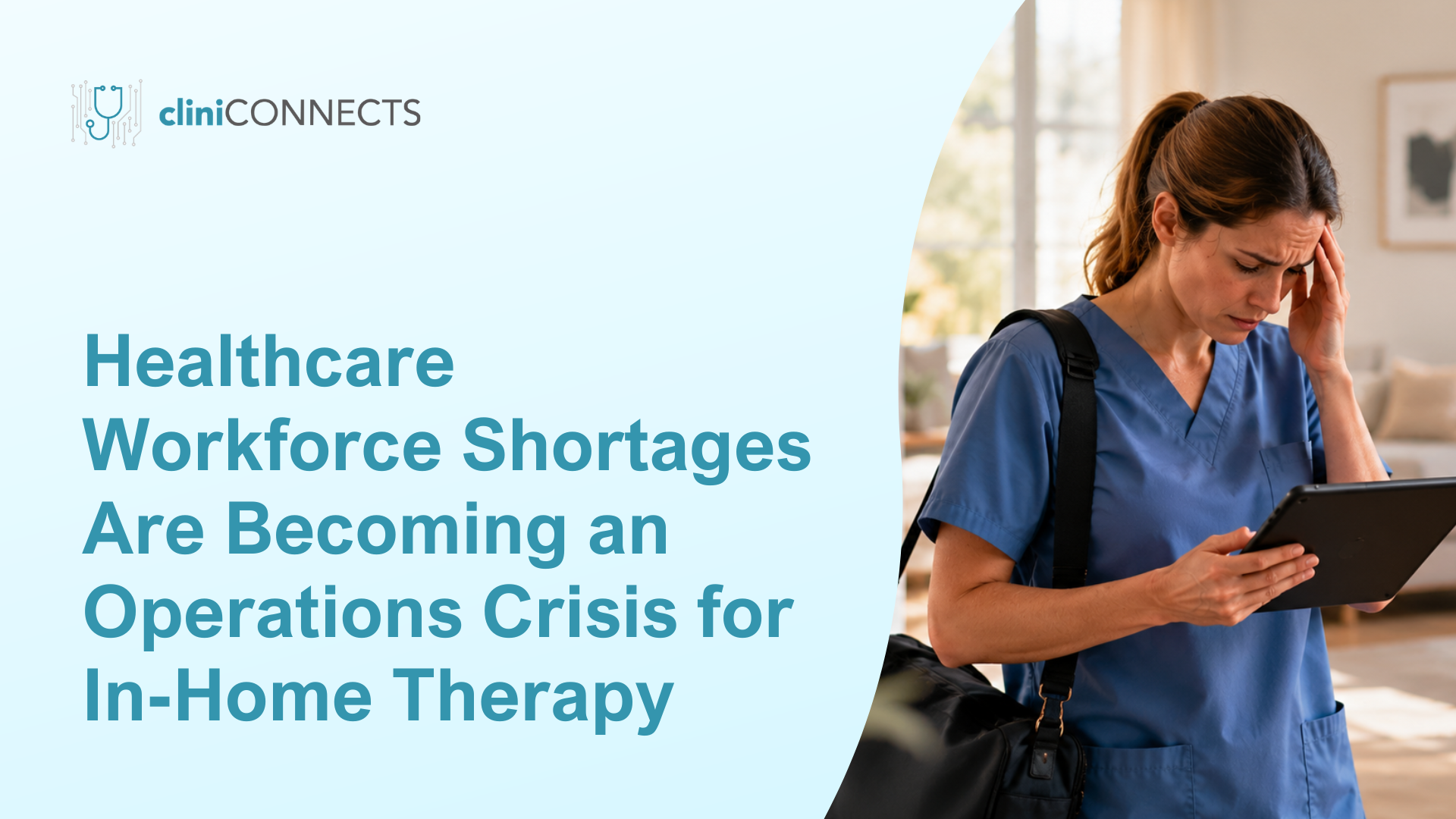
America does not just have a healthcare hiring problem.
It has a care coordination problem.
A Business Insider report found that more than 702,000 healthcare job vacancies are posted each month, while only about 306,000 unemployed healthcare workers are available nationwide to fill them. The gap is even more severe in rural areas, where 85% of healthcare executives report difficulty finding enough local talent, compared with 45% in cities.
For patients, this means longer waits and fewer available appointments.
For in-home therapy providers, the impact is even more operationally complex.
In-home physical therapy, occupational therapy, speech therapy, and mobile rehab services depend on the ability to match the right clinician to the right patient — at the right time, in the right geography, with the right credentials.
When clinician supply is tight, every scheduling delay, credentialing gap, and manual workflow becomes more expensive.
The Workforce Gap Is Not Going Away Quickly
The healthcare workforce shortage is not a temporary inconvenience.
According to HRSA’s National Center for Health Workforce Analysis, the U.S. is projected to face long-term shortages across multiple healthcare roles through 2037, including registered nurses, licensed practical nurses, physicians, and other clinical professionals.
For in-home therapy agencies, this matters because care delivery is already harder to coordinate than facility-based care.
A clinic schedules patients into rooms.
An in-home therapy agency coordinates clinicians across:
• Service areas
• Patient homes
• Availability windows
• Credentials
• Specialties
• Referral sources
• Visit confirmations
• Billing and payroll
That means the shortage is not only about having enough clinicians. It is about using available clinical capacity more intelligently.
The Hidden Problem: Shortages Expose Workflow Weakness
Most workforce conversations focus on hiring.
But for in-home therapy organizations, the bigger issue is operational drag.
A shortage affects:
• How quickly referrals are accepted
• Whether patients are matched with the right therapist
• Whether clinician credentials are current
• Whether schedules stay accurate
• Whether missed visits are caught early
• Whether completed visits flow into billing and payroll
• Whether leaders can see capacity across the organization
Becker’s Hospital Review reported that 50% of healthcare executives say staff shortages have moderately or significantly reduced their ability to serve patients.
That should concern every in-home therapy operator.
When capacity is already limited, manual coordination becomes a bottleneck.
Why In-Home Therapy Needs Better Workflow Automation
In-home therapy is operationally different from traditional healthcare delivery.
A single referral may require several decisions before care begins:
1. Which therapist has the right specialty?
2. Is the therapist available?
3. Is the therapist close enough to the patient?
4. Are their credentials current?
5. Can they accept the referral?
6. Has the patient been scheduled?
7. Has the visit been confirmed?
1. Will billing and payroll connect after the visit?
If those steps happen through spreadsheets, phone calls, texts, and disconnected systems, agencies lose speed and visibility.
That is why healthcare workflow automation is becoming essential for in-home therapy.
It does not replace clinicians. It helps agencies coordinate scarce clinical capacity more efficiently.
What CliniConnects Solves for In-Home Therapy Agencies
CliniConnects is a cloud-based SaaS platform built to automate operational workflows for in-home healthcare, therapy agencies, rehab networks, and mobile-care providers.
It is not a full EMR and does not replace enterprise hospital systems.
Instead, CliniConnects supports the operational layer around in-home therapy delivery, including:
• Patient-clinician matching
• Scheduling and visit management
• Credentialing and compliance
• Billing, invoicing, and payroll
• Reporting and analytics
This matters because many in-home therapy agencies already have clinical documentation systems. What they often lack is a connected operational workflow from referral intake to completed visit.
Clinician Matching Is Now a Capacity Strategy
When therapists are harder to find, matching accuracy becomes critical.
Agencies cannot afford to waste time contacting therapists who are unavailable, outside the service area, missing credentials, or not aligned with the patient’s therapy needs.
CliniConnects supports automated matching based on:
• Credentials
• Specialty
• Availability
• Geography
It also supports real-time clinician referral opt-in.
For in-home therapy agencies, this can reduce manual back-and-forth and help move referrals toward scheduled visits faster.
Credentialing Is Not Just Compliance — It Affects Access
Credentialing is often treated as a back-office task.
But in in-home therapy, credentialing affects whether a patient can receive care on time.
If a therapist’s license, credential, or compliance status is unclear, scheduling can stall. If credential checks happen too late, agencies risk delays, rework, or improper assignment.
CliniConnects supports:
• License and credential tracking
• Expiry alerts
• Assignment safeguards
That helps agencies catch problems before they affect patient care or operational flow.
Scheduling Pressure Is Higher in In-Home Therapy
In-home therapy scheduling is not simple calendar management.
It involves travel time, geographic coverage, patient availability, clinician availability, visit confirmations, rescheduling, and real-time updates.
When workforce shortages increase, schedule efficiency becomes even more important.
CliniConnects supports multi-site scheduling, real-time updates, visit confirmations, reminders, and rescheduling workflows.
For agencies managing physical therapists, occupational therapists, speech therapists, or other mobile clinicians, this kind of structure helps reduce administrative friction.
Billing and Payroll Are Part of the Therapy Workflow
A therapy visit is not operationally complete when the therapist leaves the patient’s home.
The visit still needs to connect to:
• Invoice generation
• Payment tracking
• Clinician payroll
• Profitability visibility
If billing and payroll are disconnected from completed visits, agencies face delays, errors, and margin blind spots.
CliniConnects supports per-visit invoice generation, payment tracking, clinician payroll management, and profitability controls.
That is especially important for agencies working across multiple clinicians, locations, referral sources, and visit types.
The Bigger Access Risk
The workforce shortage is happening alongside financial pressure across healthcare.
Business Insider reported that nearly 800 rural hospitals are currently at risk of closure due to financial challenges. As hospitals reduce services or close, more pressure can shift into outpatient, community-based, and home-based care models.
For in-home therapy providers, that creates both opportunity and strain.
Demand may rise.
But without stronger operational systems, agencies may struggle to absorb that demand efficiently.
The New Standard for In-Home Therapy Operations
The future of in-home therapy will not be defined only by who can hire more clinicians.
It will be defined by who can coordinate available clinicians better.
A modern in-home therapy operating model should include:
• Automated patient-therapist matching
• Real-time referral visibility
• Multi-site scheduling
• Visit confirmations and reminders
• Credential tracking and expiry alerts
• Billing and payroll alignment
• Dashboards for utilization, referrals, compliance, finances, and trends
These capabilities help agencies move from reactive coordination to structured operations.
Bottom Line
Healthcare workforce shortages are not just a hiring challenge.
For in-home therapy agencies, they are exposing the limits of manual operations.
When therapist availability is constrained, every referral, schedule, credential, visit, invoice, and payroll step must work more efficiently.
CliniConnects helps in-home therapy providers automate the operational workflows that connect referral intake to completed care.
In a market where clinical talent is limited and demand continues to rise, connected operations are becoming a competitive advantage.
References
- Businessinsider2 charts show why booking a doctor’s appointment is such a headache
- CovistaResearch | Covista Care Capacity Monitor
- Hrsabhw.hrsa.gov/data-research/projecting-health-workforce-supply-demand
- Beckershospitalreviewbeckershospitalreview.com/workforce/the-current-state-of-staff-shortages-per-executives
- Chqprchqpr.org/downloads/Rural_Hospitals_at_Risk_of_Closing.pdf