

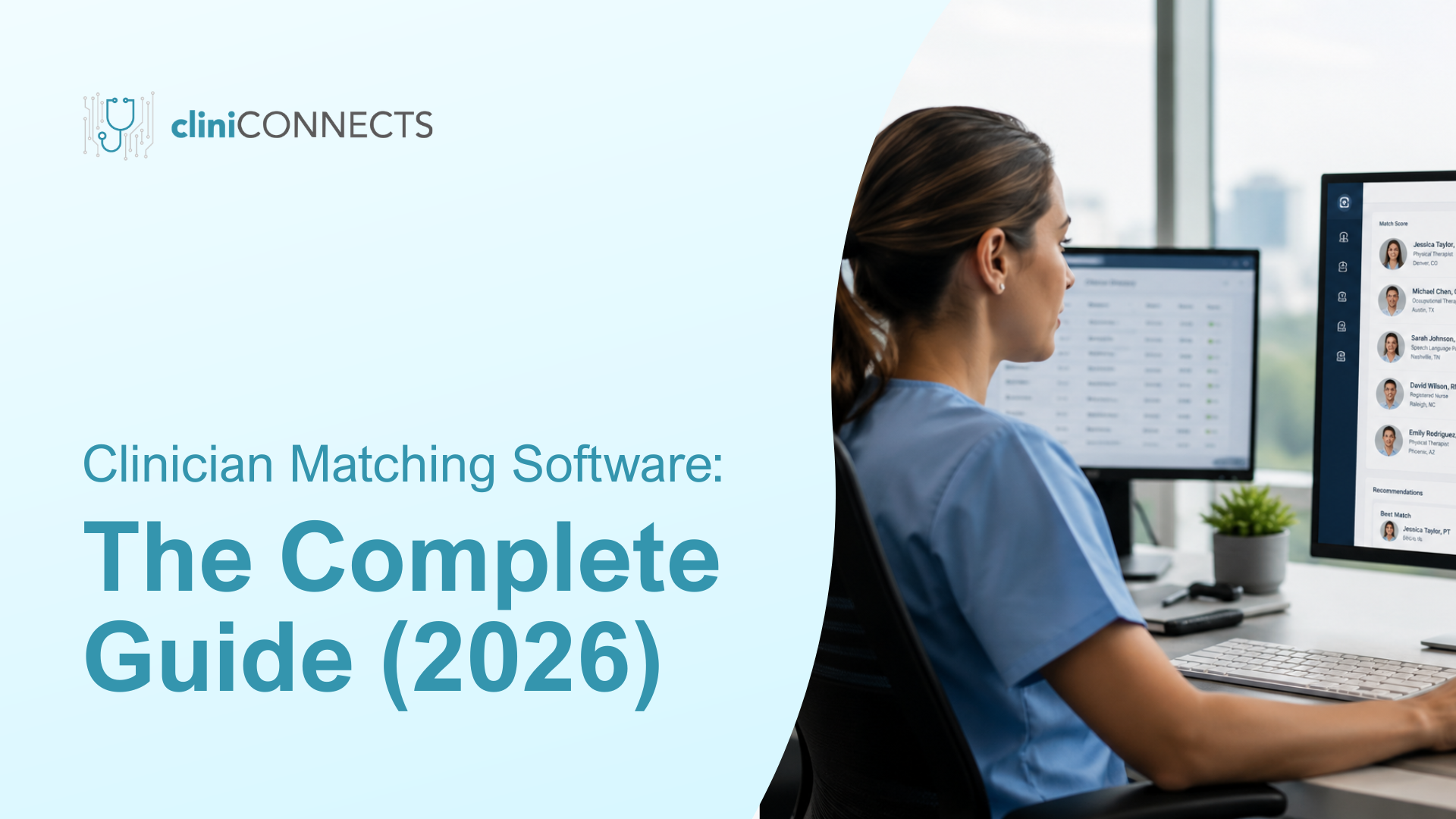
Finding the right clinician for every patient—quickly, accurately, and without hours of manual coordination—is one of the biggest operational challenges facing in-home therapy companies today. Clinician matching software solves this by automatically pairing therapists with patients based on credentials, location, specialty, and availability. The result: faster referrals, fewer scheduling errors, and better patient outcomes. In this guide, you’ll learn exactly how the technology works, what features matter most, and how to choose the right platform for your agency.
What Is Clinician Matching Software?
Clinician matching software is a digital platform that automatically assigns healthcare providers to patients or appointments based on a defined set of criteria—such as clinical specialty, geographic coverage zone, active licensure, and real-time availability. Rather than relying on a coordinator to manually cross-reference spreadsheets or make phone calls, the system runs an algorithm that surfaces the best-fit clinician and notifies them instantly.
In the context of in-home therapy, this means a patient referral that once took hours to process can be assigned and confirmed in minutes.
How Clinician Matching Software Works
Modern automated matching platforms follow a structured workflow from intake to assignment:
- Referral intake — A new patient case enters the system, either manually entered or imported from a referral source or EHR.
- Criteria evaluation — The algorithm evaluates all available clinicians against the case requirements: specialty (e.g., physical therapy, occupational therapy, speech therapy), geographic zone, credential status, and current schedule.
- Optimal match selection — The system ranks and selects the best-fit clinician, or presents a shortlist to a coordinator.
- Automated notification — The matched clinician receives a real-time push notification to accept or decline the referral from their mobile device.
- Confirmation and scheduling — Upon acceptance, the visit is locked into the schedule, triggering billing and documentation workflows automatically.
This end-to-end automation eliminates the manual bottlenecks that slow most agencies down.
Key Matching Criteria Used by Clinician Matching Software
The most effective platforms evaluate multiple dimensions simultaneously:
▪ Clinical specialty and discipline — PT, OT, SLP, home health aide, and more.
▪ Active licensure and credential status — The system only considers clinicians whose licenses are current and verified.
▪ Geographic coverage zone — Clinicians are matched to patients within their service radius, minimizing travel burden.
▪ Availability and schedule — Real-time calendar data prevents double-booking and assignment conflicts.
▪ Patient-specific requirements — Language preference, acuity level, payer type, and prior care history can all factor into matching logic.
Top Benefits of Clinician Matching Software for Healthcare Agencies
Faster Referral Processing
Manual referral coordination requires a coordinator to identify available clinicians, confirm credentials, and make contact—often across phone calls and email chains. Automated matching compresses this process from hours to minutes. Agencies that implement this technology report significantly faster intake-to-assignment cycles, which translates directly to better patient satisfaction and faster revenue realization.
Reduced Administrative Overhead
Staffing coordinators in in-home therapy companies can spend the majority of their day on logistics: matching, calling, confirming, re-assigning. The right platform offloads this work to automation, freeing your team to focus on exceptions, escalations, and growth. According to research published in NCBI’s PubMed Central, automated matching systems dramatically reduce the time clinical staff spend on pre-screening and assignment tasks compared to manual methods.
Improved Compliance and Credentialing Accuracy
One of the highest-risk points in healthcare staffing is assigning a clinician with an expired or incomplete credential. Clinician matching software solves this by integrating credential tracking directly into the matching logic—a clinician with a lapsed license is simply never surfaced as a match. This reduces compliance risk and simplifies audit preparation.
Scalability Without Headcount Growth
As your patient volume grows, manual coordination doesn’t scale. Adding more patients means adding more coordinators—unless you have automation in place. A robust platform allows agencies to double or triple their referral volume without a proportional increase in administrative staff. This is one of the primary drivers of ROI for growing in-home therapy companies.
Better Clinician and Patient Experience
Clinicians receive timely, relevant assignment notifications rather than unsolicited calls. Patients get matched to qualified providers faster. Reduced scheduling errors and fewer last-minute reassignments also contribute to continuity of care—a factor that research from Nature Health links to improved clinical outcomes in provider-matching contexts.
Clinician Matching Software vs. Manual Scheduling: A Side-by-Side Comparison
| Factor | Manual Scheduling | Clinician Matching Software |
| Referral-to-assignment time | Hours to days | Minutes |
| Credential verification | Manual lookup required | Automated, built into matching logic |
| Risk of expired license assignment | High | Eliminated |
| Scalability | Limited by coordinator capacity | Scales with software |
| Real-time clinician notification | Phone/email | Instant push notification |
| Scheduling conflicts | Common | Prevented algorithmically |
| Audit readiness | Manual documentation | Automated record-keeping |
| Admin hours per referral | High | Minimal |
Key Features to Look for in Clinician Matching Software
Not all platforms are created equal. When evaluating your options, prioritize these capabilities:
Automated Assignment Algorithms
The core engine should match on multiple criteria simultaneously—specialty, zone, credential status, and availability—not just one or two fields. The more dimensions the algorithm evaluates, the more accurate and appropriate the results will be.
Real-Time Clinician Notifications
Static assignment emails are insufficient for modern in-home therapy operations. Your platform should deliver instant mobile push notifications so clinicians can accept or decline referrals immediately—keeping schedules accurate without coordinator follow-up.
Credential Tracking Integration
Matching and credentialing should live in the same system. When credential data is embedded in the matching engine, expired licenses, missing certifications, or compliance gaps are automatically excluded from the candidate pool. Look for platforms that send automated renewal reminders to both clinicians and administrators.
Mobile Accessibility
Field-based clinicians need access from their phones. The best tools include a dedicated mobile app where therapists can manage schedules, confirm visits, and record notes—anywhere, anytime.
EHR and Billing Integration
Your staffing platform should connect cleanly with your existing EHR system and financial tools (such as QuickBooks) to eliminate duplicate data entry and streamline post-visit billing.
Analytics and Reporting
Coverage gaps, underutilized clinicians, and assignment acceptance rates are the metrics that drive staffing strategy. Choose a solution that surfaces this data in easy-to-read dashboards and exportable reports.
How CliniConnects Automates Clinician Matching
CliniConnects is purpose-built for in-home therapy companies that need intelligent, automated staffing operations. The platform’s Scheduling & Matching module uses a smart algorithm to pair patients with therapists based on coverage area, clinical specialty, credential status, and real-time availability—automatically and without manual intervention.
Key capabilities include:
▪ Auto-assign referrals — The algorithm instantly identifies the best-fit clinician and notifies them via the mobile app to accept or decline.
▪ Real-time schedule updates — Accepted referrals are locked into the schedule immediately, with no risk of double-booking.
▪ Seamless referral workflow — From intake to assignment, every step is automated, reducing manual errors and administrative workload.
▪ Credential-aware matching — Assignments always reflect current license and certification status, eliminating compliance blind spots.
CliniConnects combines clinician matching software with integrated healthcare staffing tools—including credentialing, billing, payroll, and analytics—into a single platform designed exclusively for in-home therapy providers.
Ready to Automate Your Clinician Matching?
Manual staffing coordination is a bottleneck your agency can’t afford to maintain. Clinician matching software removes the guesswork and the phone tag—giving your coordinators their time back while ensuring every patient is matched to the right clinician, every time.
Request a Demo of CliniConnects to see automated clinician matching in action and find out how quickly your agency can get started.
Frequently Asked Questions
What does clinician matching software do?
It automatically assigns qualified healthcare providers to patient cases based on specialty, credentials, geographic zone, and availability. The platform replaces manual coordinator workflows with algorithmic automation, reducing assignment time from hours to minutes.
Is this the same as scheduling software?
ot exactly. Scheduling tools manage appointment calendars. Clinician matching software handles the step before scheduling—determining which clinician should be assigned to which patient. The best platforms do both, integrating matching logic directly into the scheduling workflow.
How does the system verify credentials?
Most clinician matching software maintains a credential database that tracks license expiration dates, certifications, and compliance requirements. When a referral comes in, the algorithm automatically filters out any clinician whose credentials don’t meet the case requirements or whose licenses are expired.
Can it integrate with my existing EHR?
Yes—leading platforms offer API-based integrations with major EHR and EMR systems, allowing referral data to flow in automatically and visit documentation to sync back without duplicate entry.
What size agency benefits most?
The technology delivers ROI at nearly any volume, but the value compounds as referral volume grows. Agencies managing more than 20–30 active cases at a time typically see the strongest impact, as the administrative burden of manual matching at that scale becomes unsustainable.
How long does implementation take?
Timelines vary by platform and integration complexity. Purpose-built solutions like CliniConnects are designed for fast onboarding, with demos available to walk your team through the full setup.